Why Couples Need You to Support Independent Celebrants Now
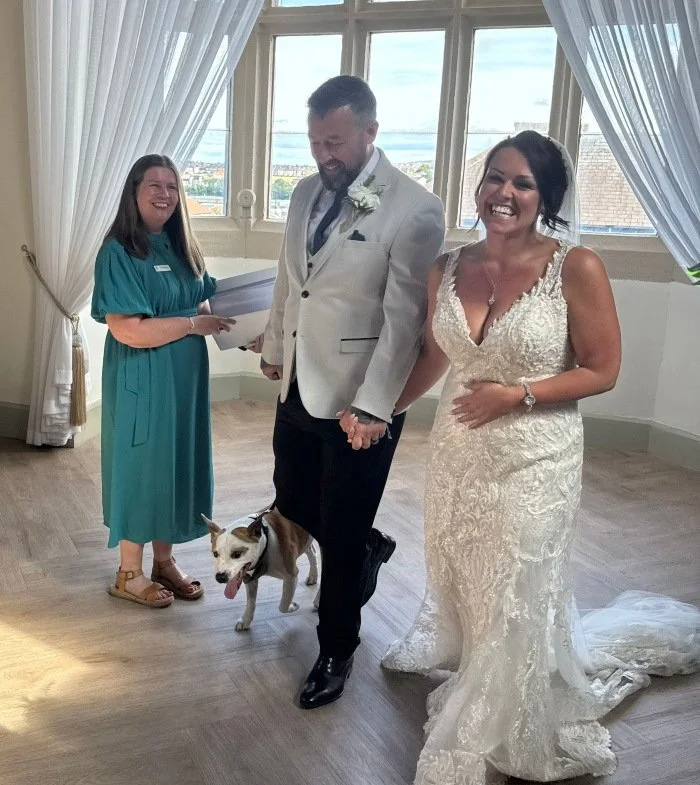
Kate, a couple and their dog at their ceremony.
Imagine planning your wedding and realising there’s no legal ceremony option that truly reflects you and the one you love! Well, many couples in England and Wales who face this reality. Increasing numbers of couples overcome this with a celebrant led wedding.
Whether you already know the benefits of a celebrant led wedding or it is your first time thinking about this, I encourage you to read on. We are on the cusp of change when it comes to wedding law. This change has the potential to place independent celebrants at the heart of ceremony choices for couples in England and Wales for years to come.
What is the Problem with Current Wedding Law?
Marriage in England and Wales falls under the Marriage Act of 1836 and amendments to it. I focus on one key concern with this law, restricted ceremony choices.
There are two types of legally recognised wedding ceremonies. One is a religious wedding ceremony officiated by clergy from a select list of faiths, in their place of worship. The other is a wholly secular ceremony officiated by a local authority registrar in a venue licensed for weddings.
Your choice is to either have a religious or civil wedding in licensed venues and with heavily regulated religious or civil content. If you don’t fit the current binary, there is no third option, not legally anyway.
So, if you are an interfaith couple, or one of you is religious and the other isn’t, or even if you just view faith and spirituality a little differently, you are in the space between the binary.
As it stands, one or both of you would likely have to quell your beliefs to have a legal marriage ceremony. Whichever way you look at it, inequality is built in.
How Couples Overcome Restrictions with a Celebrant
Couples choose a celebrant led ceremony to overcome restrictions of a legal ceremony. In doing so, they get to hold their ceremony where and when they want and choose every element of the content.
With independent celebrants, couples are free to be creative about how they bring their individual and collective beliefs, including their faith, into the ceremony.
Bringing identity and beliefs into the ceremony is important to many couples. A survey of independent celebrants found that they “blend religious and secular content or combine content from different religious or cultural traditions,” (Pywell, 2020: 24).
How do couples achieve such freedom of choice I hear you ask? Well, it comes from the fact that a celebrant led ceremony is not legally binding. So, while couples can get the personalised ceremony that holds most meaning to them, this choice comes at a cost.
Holding Two Ceremonies: A Trade-Off
The trade-off is for having a celebrant led ceremony having to undertake a separate legal process with a registrar. Without it the couple won’t be recognised as legally married.
Celebrants often guide couples about the simplest way of meeting the legal requirement (an appointment with the registrar where the couple and two witnesses sign the register). However, there is no denying this adds to the effort required from the couple.
Something is amiss when a couple’s legal wedding is an administration task and the personalised ceremony is not legally recognised. If this affects you, you are entitled to ask why the ceremony that reflects you and your loving relationship is not the one that legally counts.
This Issue Affects the Lives of Real People
I have met couples who have been deeply affected by this issue, both in my personal life and as a celebrant. These include:
Couples with families, mortgages etc. who want the security of marriage but who don’t want an inauthentic ceremony
A long-term couple with one approaching the end of life, who need to marry without delay
A couple wanting a blend of religious content to enable a sense of belonging for close family members
A couple of faith not wanting a church wedding, due to historic abuse from a member of the clergy
It really is not too much to ask that couples such as these have meaningful and legal wedding ceremonies.
How Is the Law Likely to Change?
In October 2025 government announced it would reform wedding law using this 2022 Law Commission Report as a reference (link is underlined). This report recommends licensing officiants rather than venues, giving couples more affordable wedding venue options.
The announcement stated that discrimination experienced by humanist couples would be removed. However, it has not been decided whether independent celebrants would be allowed to legally marry. This decision will be part of the public consultation.
The prospect of humanist couples being able to legally marry as part of their humanist ceremony is great - I love that for humanist folk. However, on its own, it will not remove the beliefs-based discrimination baked into wedding law.
The only way to remove discrimination is to enable loving, consenting couples to legally marry each other in a ceremony where they can express their beliefs with honesty.
How Can the Law be Changed?
If we agree that limiting legal marriage ceremonies to certain faiths / beliefs is discriminatory, we must ask what we should do. I believe the answer lies in taking a rights-based approach.
Did you know that you have a human right to hold your own beliefs? This right is in UK and international human rights law. Article 9 of the Human Rights Act 1998 UK (link underlined) states:
“Everyone has the right to freedom of thought, conscience and religion; this right includes freedom to change his religion or belief and freedom, either alone or in community with others and in public or private, to manifest his religion or belief, in worship, teaching, practice and observance”
We already know that officiants will be licensed in future, rather than venues. This provides the solution, which is to license independent celebrants to hold legal weddings for couples whose beliefs aren’t otherwise represented. This would be the much-needed third option.
Prof. Pywell who surveyed independent celebrants proposed giving couples real choice of wedding officiant (see Beyond Beliefs). Indeed, the 2022 Law Commission Report sets out how independent celebrants could be regulated to hold legal weddings, if the government wishes.
So, we have the practical means to achieve the goal. We just need the political will. And that’s where you come in.
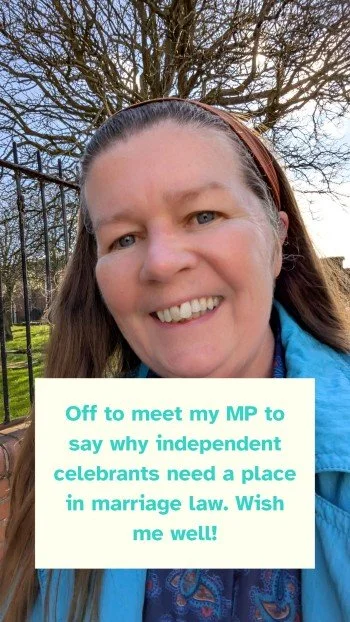
Kate on the Way to Meet her MP
Couples and Allies, You Can Make a Difference - Contact Your MP!
Members of Parliament (MPs) will decide whether to include independent celebrants in wedding law. To make the decision that work enables choice for couples they need to understand why this is important.
MPs have a responsibility to respond to their constituents. If you are or have been personally affected by the current legal restrictions, you are the perfect person to enlighten your MP. Your real-life experience and insight carry a lot of power, more than you might realise.
You can send an email to your MP in a matter of minutes and can find their email address using this underlined link: Find MPs - MPs and Lords - UK Parliament . If writing to your MP feels daunting, you can get ideas and inspiration from the underlined link to the website of Give Couples Choice Movement .
One quick action from you could make a huge difference. I know because I recently wrote to my own Member of Parliament, Emma Lewell MP. I then had the opportunity to speak to her. She quickly said she was happy to support independent celebrants as legal officiants. It felt great!
Why Act Now?
We have a rare opportunity to influence MPs with the public consultation that will take place this year. We need to act now to win their hearts and minds.
Whether you are nearly wed, newly wed or long since wed, if you understand the importance of independent celebrants, I ask you to use your voice with your local MP.
Based on experience it could be 190 years before another marriage act comes along. We can help shape the future of weddings in England and Wales, not just for you and your family, but for generations of couples to come.